Three Kinds of Damp, One of Them Curable by Insulation
Nearly every damp problem in an Irish house is one of three things, and telling them apart before anyone quotes for insulation is the single most useful thing a homeowner can do.
Condensation is moisture from the air landing on a cold surface. It shows up as black spotted mould in corners, behind furniture on external walls, and around window reveals, and it is worst in winter and in the rooms that generate moisture. This is the one insulation cures, because it works by making the surface warm enough that moisture stops condensing on it.
Rising damp comes up from the ground through the wall. It stops at a fairly consistent height, typically under a metre, often leaves a tide mark with salt deposits, and does not care what the weather is doing. It needs a damp-proof course, not insulation.
Penetrating damp comes through the wall from outside via a defect: a cracked render, a failed gutter, a blocked downpipe, poor pointing. It appears as a patch rather than a band, it is usually worse after rain, and it needs the defect repaired.
The one-line test
Black spotted mould in corners and around windows, worse in winter, is condensation and insulation will help. A defined patch that worsens after rain, or a band along the bottom of the wall with a tide mark, is water getting in and insulating over it will trap it.
How Insulation Cures Condensation
Air holds moisture, and the colder a surface is, the more readily that moisture condenses onto it. An uninsulated external wall runs several degrees colder than the room, and the corners and reveals run colder still, which is exactly why the mould appears there and not in the middle of the wall.
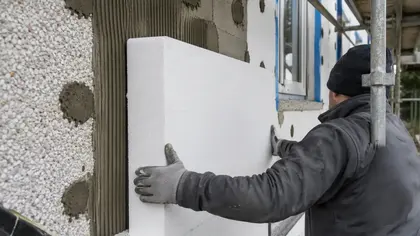
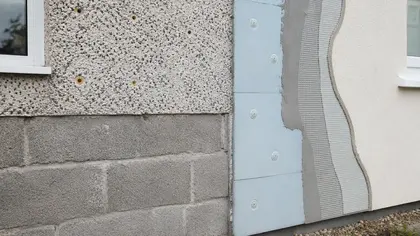
Insulation raises the temperature of the inner surface. Once it stays above the point at which moisture condenses, the condensation stops and the mould has nothing to grow on. That is why external wall insulation in particular is such an effective treatment: it keeps the entire wall warm, corners included.
It is not a substitute for ventilation. Insulating a house tightens it, and the moisture a household generates has to go somewhere, so extract fans in the kitchen and bathroom need to work and trickle vents need to stay open.
What Goes Wrong When You Insulate Over a Problem
Insulating over an active leak does not stop the water. It puts a layer over the top of it, which means the wall behind stays wet, dries more slowly than it did before, and is no longer visible from inside the room. A problem you could see becomes a problem you cannot.
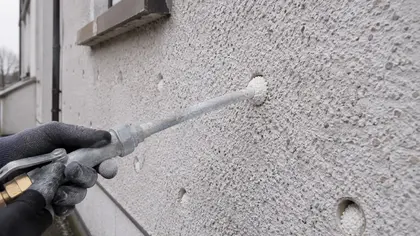
On a cavity wall there is a second version of this. The cavity partly exists to stop water crossing from the outer leaf to the inner one, so filling a cavity in a wall that is already letting water in can carry that water inward. This is precisely what the pre-works borescope survey is for, and a contractor who skips it is the risk rather than the measure.
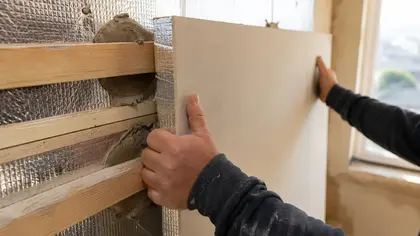
Internal dry lining carries its own version. Insulating the inside leaves the wall itself cold, so any junction the insulation does not cover cleanly, at floors, ceilings and reveals, becomes the coldest point in the room and the new place moisture condenses. Good detailing is what prevents that, and it is worth asking how a contractor handles reveals before agreeing anything.
- Fix any leak, failed gutter or cracked render before insulating
- Resolve rising damp with a damp-proof course first
- Insist on a borescope survey before any cavity is filled
- Ask how reveals and floor junctions are detailed on internal work
- Check extract fans work, and keep trickle vents open afterwards
The Order to Do Things In
Repair first, insulate second, ventilate throughout. That order is not a preference, it is the difference between insulation solving a damp problem and insulation concealing one.
If you already have mould, clean it back before the work starts so you can tell afterwards whether it is returning. If it comes back on an insulated wall, that is a strong signal the cause was never condensation.